Take Action This Mental Health Awareness Week.

Mental Health Awareness Week is upon us and this year the theme is ‘action’, which I really like. Here are some brief thoughts on why I think action is so important.
There has been some brilliant work done in recent years around mental health awareness. Mental health has been brought right into the mainstream conversation. Understanding and acceptance of the topic of mental health have both improved massively. There’s still a long way to go, but there's so much incredible work being done every day. Work within charities, in the therapy room, in informative content creation - loads of places.
But what comes next?

If mental health becomes a perpetual game of awareness we run the risk of, on one side, irritating and alienating large chunks of the population tired of hearing about 'mental health awareness', and on the other, raising awareness of mental health difficulty in people's lives, with no viable route to what has to come next: support.
The NHS is facing record demand, with 5.2 million referrals in 2024 resulting in over 16,500 people waiting over 18 months for support. 16,500 lives. Some people don’t have 18 months to wait for support. Waiting lists are struggling and often other routes to support are made unnecessarily difficult because of barriers that exist within aging, traditional business models, that appear more intent on ticking boxes than providing quality, easy-to-access care that people actually use and benefit from.
The theme of action is absolutely spot on, because action is precisely what’s needed.
Within ‘action’, though, there’s an important distinction to make between ‘perceived action’ and ‘actual action’.
Action for the sake of action, that looks like action, but actually doesn’t result in much action, isn’t really action.
I bet you didn’t expect to read a sentence where 1 in 4 words were ‘action’ did you? Did it feel like you read ‘action’ a lot? It felt like a lot writing it.
That’s precisely the proportion of the population that we know tussle with mental health difficulties in any given year, that’s how common mental health difficulty really is, 1 in 4. It is real and it is common and it is human, and that’s okay, if actual action is taken to make sure support is available, accessible and high quality. Ticking a box that says ‘we support our employees through our EAP that costs almost nothing each year’ isn’t actual action, it’s perceived action.
The economics hide in plain sight. A free add-on EAP, or something that costs around £3-£10 per person, per year is incredibly unlikely to result in actual widespread access to quality support for employees. Something has to give.
It looks a lot like a lot of EAPs survive because as few as 3-5% of people use them. And only 68% of people contacting their EAP were offered counselling in 2022.
For those that receive support, if the support is high quality and helps make a difference in their lives, then that’s great, I support quality support. When that isn't the case, actual action has to be taken, because we can do things in a much better way.
So what action can you take?
For individuals, I have three very simple questions to ask yourself, with your mental wellbeing in mind:
What could you do with more of in your life?
What could you do with less of in your life?
And with those answers in mind:
What action can you take this week?
Action is different for everyone. My favourite part of mental wellbeing support is that you are the expert of your own life. You are the only person who has lived every second of it. You get to decide what action to take.
Action could be as simple as connecting with a friend or going for a walk, maybe reducing that screen time.
Whatever works for you.
If you’re clear on your answers and the action you can take, great, go for it, take action.
If you’re not, that’s where therapy could help.
A safe, non-judgemental space to better understand yourself and get clarity on what might help you live a fuller life.
For Workplace Leaders, Founders, Heads of People and HR, I have these questions:
Can you confidently say your teams can access quality mental wellbeing support, whenever they want it?
Can they access support without needing to ask anyone where to find it or how to use it and without calling a call centre to speak with a stranger at a potentially very vulnerable time?
If the answers to those questions are a resounding yes, I have nothing to add, no notes, great work!
If there is even a hint of ‘No’ or ‘I’m not sure’:
What action can you take this week to ensure quality support is there for your people when they want it, not need it, so that they can proactively support their own mental wellbeing?
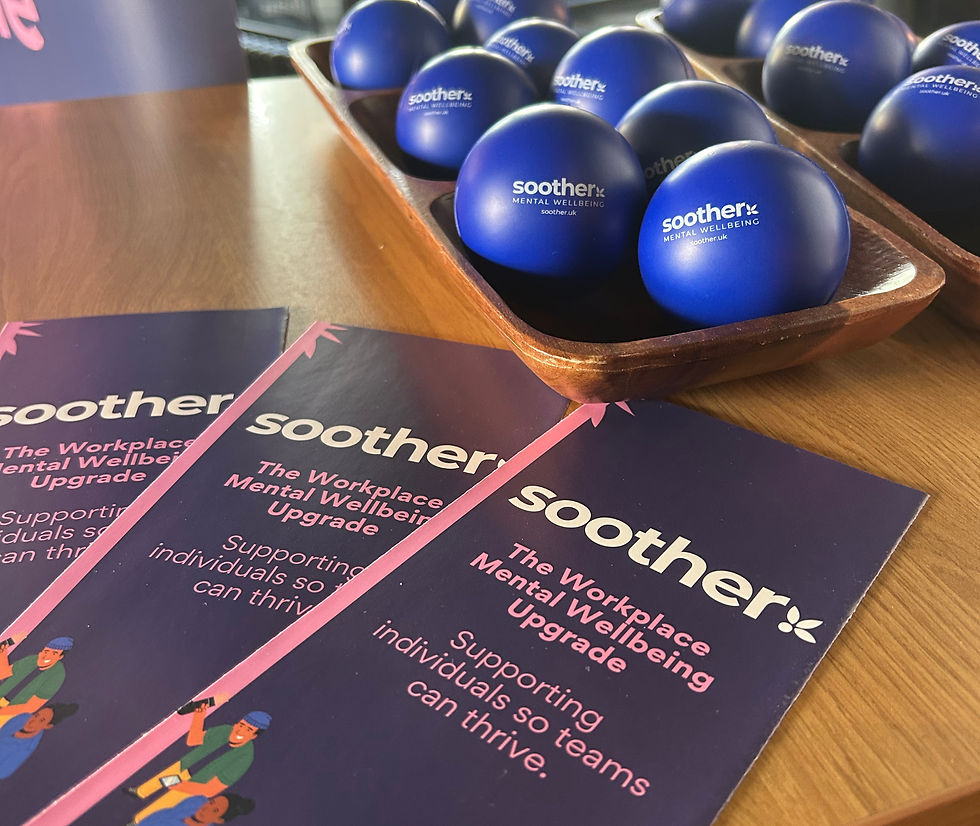
At Soother we build workplace mental health partnerships. Partner employees know exactly what support they have access to and how to access it, without needing to ask.
Approaching mental health proactively with high quality therapy on the front foot, because therapy before a crisis could prevent someone ever reaching one. Better for employees, better for businesses, better for everyone.
So this Mental Health Awareness Week, what action will you take?